CS2 gambling covers several activities connected to Counter-Strike 2, including skin-based wagering, roulette-style games, crash games, case openings, live gambling, and match betting.

| Format | What users wager | How it works | Main risk |
|---|---|---|---|
| CS2 skin gambling | CS2 skins, site balance, or money | Users deposit skins or funds, convert them into balance, and use that balance in gambling games. | Skins can have real market value, so losing them can be similar to losing money. |
| CS2 roulette gambling | Skins, balance, money, or crypto | Users place wagers on roulette-style outcomes such as colors, numbers, or multipliers. | Results are chance-based, and losses can happen quickly. |
| CS2 crash gambling | Skins, balance, money, or crypto | A multiplier rises until it crashes. Users must cash out before the crash point to win. | The round can end suddenly, causing fast losses. |
| CS2 case gambling | Balance, money, crypto, or sometimes skins | Users open virtual cases for a chance to receive skins or other rewards. | The reward may be worth less than the cost of opening the case. |
| CS2 live gambling | Money, balance, or sometimes skins | Users place wagers while a CS2 match or game is already in progress. | Fast-changing odds can encourage impulsive decisions. |
| CS2 match gambling | Money, balance, crypto, or sometimes skins | Users bet on professional CS2 match outcomes, such as match winner, map winner, or total rounds. | Even strong CS2 knowledge does not guarantee correct predictions. |
Some formats use real money, while others involve CS2 skins, crypto, or site balance. Before taking part in any gambling cs2 activity, you should understand how each format works, what risks are involved, and what rules apply before depositing money or skins.
CS2 gambling refers to gambling activities linked to Counter-Strike 2. Depending on the service, users may place wagers with real money, cryptocurrency, platform balance, or CS2 skins. The exact format can vary widely, which is why it is important to understand the rules before participating.

Common forms of CS2 gambling include:
Some services focus mainly on skins, while others operate more like traditional casino or sportsbook platforms with CS2-themed markets.
Not all formats work the same way. A roulette-style game is usually chance-based, while match gambling is connected to esports results. Case gambling depends on item probabilities, and crash gambling often moves quickly with a rising multiplier.
What to check before depositing:
CS2 skin gambling involves using Counter-Strike 2 skins as value, balance, or potential rewards. Skins are cosmetic in-game items, but many have real-world market value because they can be traded, sold, or purchased through supported marketplaces. This value is the reason skins are often used in gambling-related services.
In a typical CS2 skin gambling process, the flow may look like this:
Skin valuation is an important part of CS2 skins gambling because the same item may not have the same value everywhere. Before depositing any skin, users should check how the platform calculates item prices and whether fees or pricing differences apply.
| Factor | Why it matters |
| Rarity | Rare skins usually have higher market demand and may receive a higher valuation. |
| Wear condition | Factory New, Minimal Wear, Field-Tested, Well-Worn, and Battle-Scarred versions can have different prices. |
| Float value | Even within the same wear category, a lower or more desirable float can affect the skin’s value. |
| Market demand | Popular skins, weapons, or finishes may be valued higher when many users want them. |
| Liquidity | Some skins are easier to sell or trade than others, which can affect how platforms price them. |
| Recent market trends | Skin prices can rise or fall based on updates, esports demand, case availability, or trading activity. |
| Platform pricing system | A gambling service may assign a different value than Steam Market or third-party marketplaces. |
| Fees or deductions | Deposit, withdrawal, or conversion fees may reduce the final value users receive. |
Withdrawals are also important because not every service handles skin withdrawals the same way. Some platforms may allow users to withdraw skins directly, while others may require certain conditions to be met first.
Questions to check before withdrawal:
Users should treat skins like money. Losing a skin in skin gambling cs2 activity can mean losing real value, especially if the item has a strong market price. It is not just a cosmetic loss if the item could otherwise be sold or traded.
CS2 gambling includes several different formats. Each one has its own mechanics, pace, and risk level.
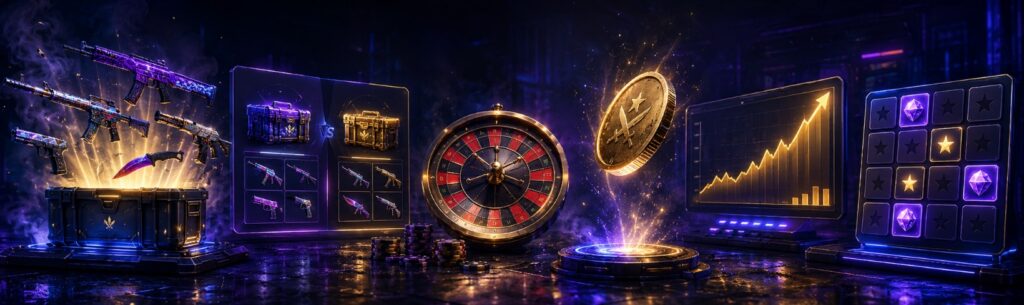
| Type | Chance or skill factor | Speed | Main risk | What to check first |
| CS2 skin gambling | Mostly chance-based, depending on the game format | Medium | Losing skins that may have real market value | Skin valuation, deposit rules, withdrawal terms, and fees |
| CS2 roulette gambling | Mainly chance-based | Fast | Quick losses from repeated roulette-style wagers | Odds, payout rules, house edge, and minimum bet size |
| CS2 crash gambling | Mainly chance-based with timing decisions | Very fast | The multiplier can crash suddenly before cash-out | Cash-out rules, round history display, limits, and risk controls |
| CS2 case gambling | Chance-based | Medium | The item received may be worth less than the case cost | Item probabilities, case price, reward pool, and withdrawal conditions |
| CS2 match gambling | Includes knowledge-based decisions, but outcomes remain uncertain | Slow to medium | Even strong CS2 knowledge does not guarantee correct predictions | Market rules, odds, match format, and settlement conditions |
| CS2 live gambling | Mix of fast decisions and match knowledge | Very fast | Rapid odds changes can encourage impulsive betting | Live odds rules, bet acceptance delays, suspended markets, and limits |
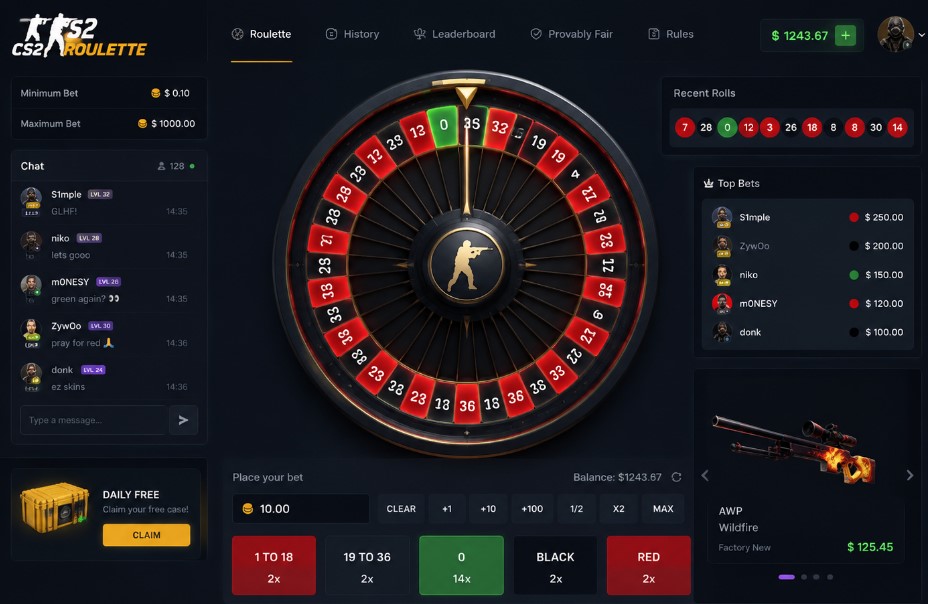
CS2 roulette gambling is usually based on roulette-style outcomes. Users may place wagers on colors, numbers, multipliers, or similar result categories depending on the game. After the round begins, the result is determined by the platform’s system, and winning wagers are paid according to the listed payout rules.
CS2 gambling roulette should not be treated as a skill-based format. While users may create patterns or personal strategies, roulette-style outcomes are mainly chance-based. Previous results do not guarantee future outcomes, and a long losing or winning streak does not make the next result predictable.
Before playing roulette-style games, users should check the payout structure, house edge, minimum and maximum bet size, and whether the platform explains how results are generated.
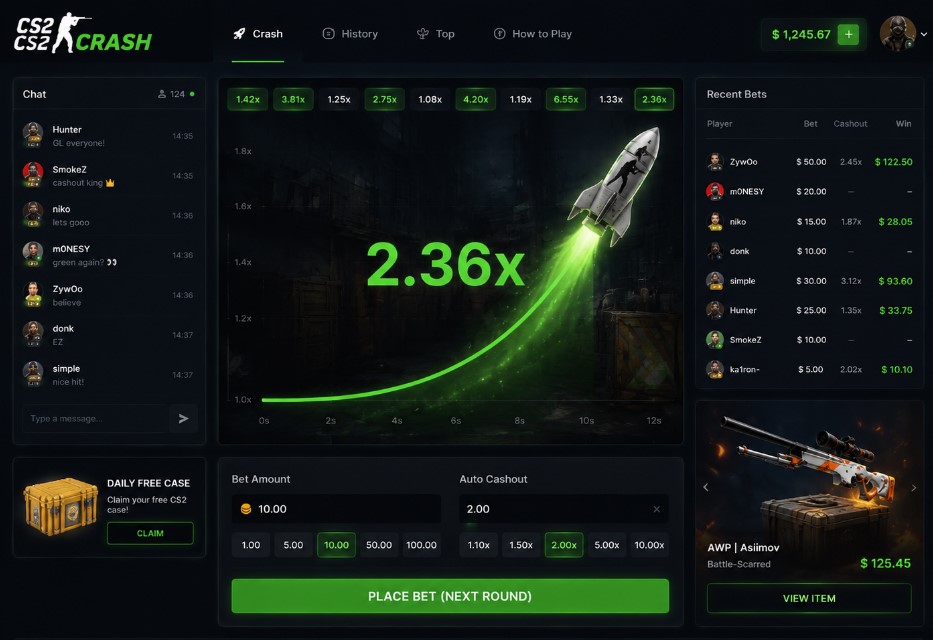
CS2 crash gambling usually involves a multiplier that starts low and rises over time. The user places a wager before the round begins and must cash out before the multiplier “crashes.” If the user cashes out in time, the payout is based on the multiplier at that moment. If the crash happens first, the wager is lost.
Crash games can feel simple, but they are high-risk because outcomes can end suddenly. A round may continue for a long time, or it may crash almost immediately. This fast pace can lead to impulsive decisions, especially when users try to recover losses quickly.
Before playing crash games, users should understand the cash-out mechanic, payout calculation, round speed, and risk of rapid losses. No betting pattern can guarantee profit in crash gambling.
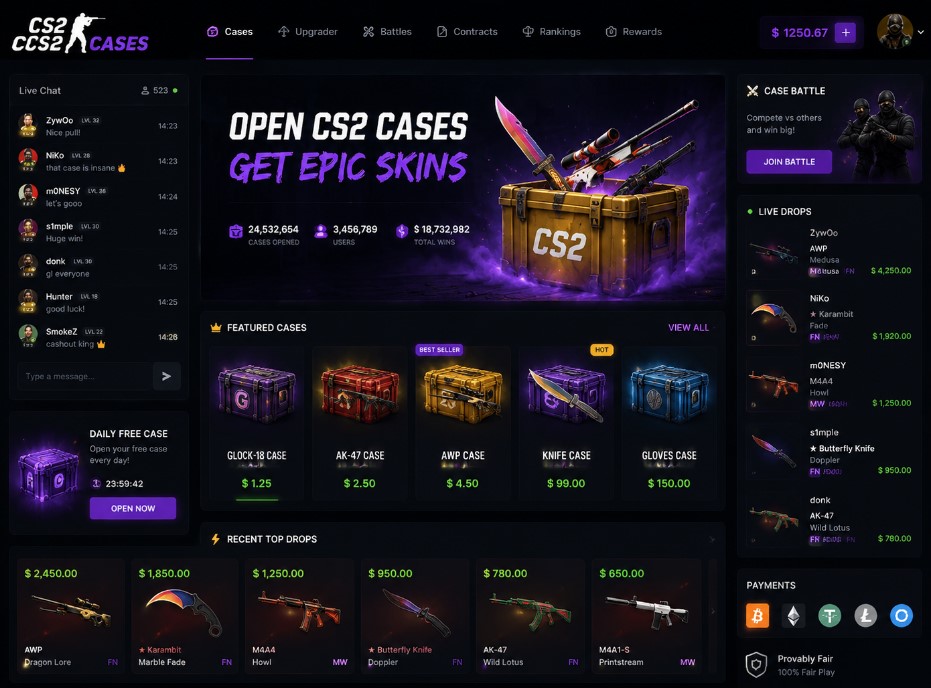
CS2 case gambling involves opening virtual cases for a chance to receive skins or other rewards. Each case usually has a set price and a pool of possible items. Some items may be worth more than the case cost, while many may be worth less.
The key detail in cs2 case gambling is probability. A case may show rare and expensive items, but the chance of receiving them can be very low. Users should check item probabilities, case prices, expected value, and withdrawal rules before opening cases.
It is also important to understand that opening cases is not the same as buying a specific skin. The result is uncertain, and the reward may be lower than the cost of the case. Users should avoid assuming that repeated openings will eventually lead to a valuable item.
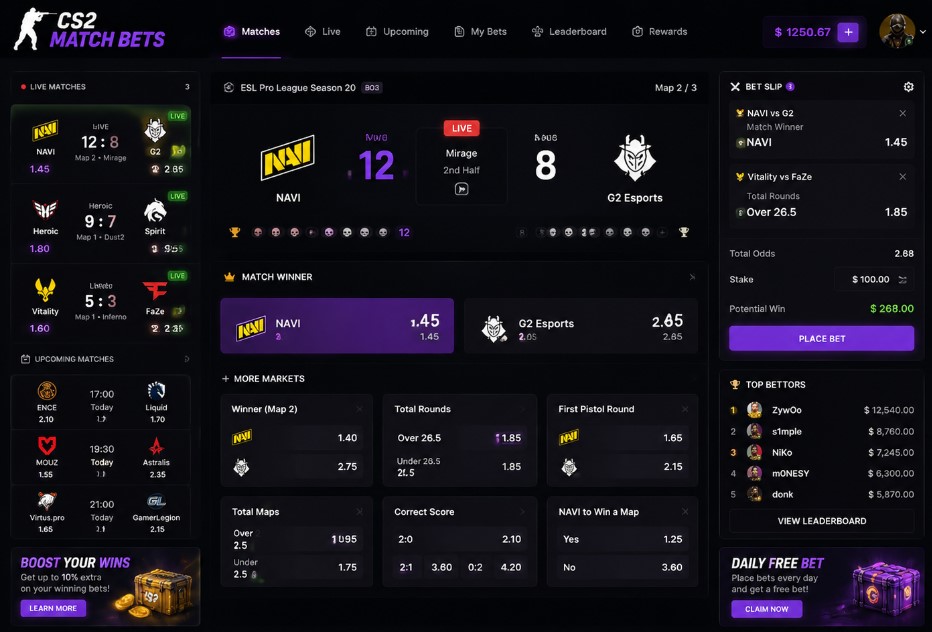
CS2 match gambling is connected to professional Counter-Strike 2 matches, leagues, and tournaments. Users may wager on outcomes such as match winner, map winner, total rounds, handicaps, pistol round winner, or tournament winner.
Knowledge of teams, players, maps, and recent form may help users understand the context of a match, but it does not remove gambling risk. Esports results can be affected by strategy changes, pressure, substitutions, technical issues, individual performance, and unexpected momentum shifts.
Before placing match wagers, users should check the market rules, settlement conditions, odds format, live score sources, and whether the event is covered by reliable data. Match gambling can still lead to losses even when a user follows CS2 closely.
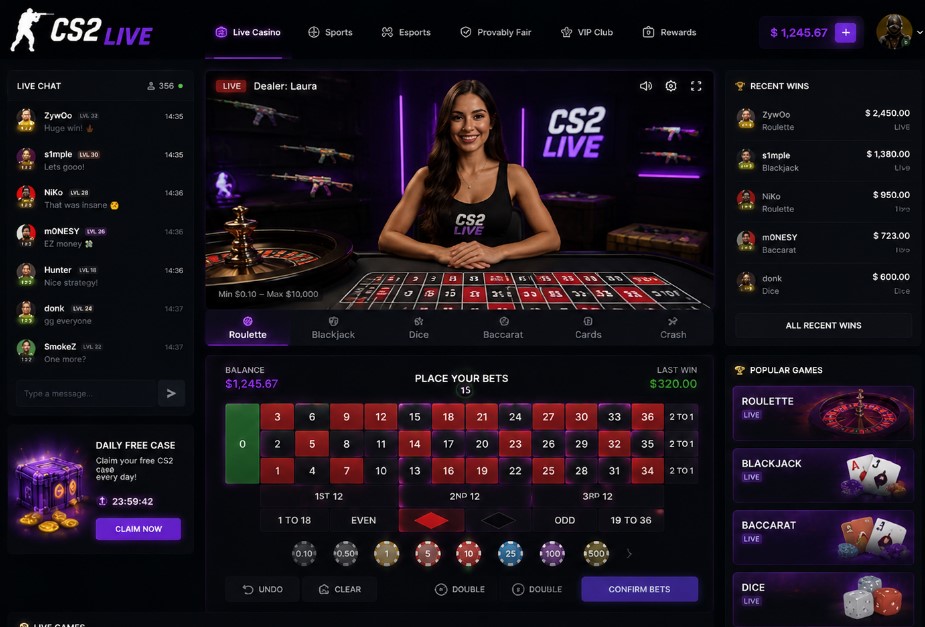
CS2 live gambling refers to wagering while a match or game is already in progress. In live match betting, odds and markets may change quickly based on the current score, round economy, map situation, player performance, or momentum. In live casino-style formats, the pace may also be faster than standard pre-match wagering.
Live gambling can be engaging because it reacts to real-time events, but it can also encourage impulsive decisions. Odds may shift within seconds, and users may feel pressure to place bets quickly. This makes it especially important to set limits before starting.
Before using live gambling features, users should understand how odds updates work, what happens if a market is suspended, and how quickly wagers are accepted or rejected.
Free CS2 gambling can mean several different things, and not all “free” offers are risk-free. In many cases, the word “free” only describes the starting offer, while withdrawals, rewards, or continued play may still come with conditions.
| Free offer type | What it usually means | Common restriction |
| Demo mode | Users can test a game without using real money or skins. | No real rewards or withdrawals are usually available. |
| Free cases | Users receive one or more cases to open without paying upfront. | Rewards may be limited, locked, or subject to withdrawal rules. |
| No-deposit bonus | A small bonus is added without requiring an initial deposit. | Wagering requirements, verification, or withdrawal caps may apply. |
| Promo balance | The platform gives temporary balance for selected games or features. | The balance may expire or may not be withdrawable directly. |
| Faucet-style rewards | Users can claim small amounts of balance at set intervals. | Rewards are usually very small and may require repeated activity. |
| Social giveaways | Rewards are offered through social media, Discord, or community events. | Users may need to meet entry rules, deadlines, or account checks. |
| Bonus funds | Extra funds are added as part of a promotion. | Wagering requirements and bonus terms may limit withdrawals. |
The main issue is that free offers often come with restrictions. A platform may require wagering before withdrawals are allowed. There may be expiry dates, account verification rules, maximum withdrawal limits, minimum deposit requirements, or region-based restrictions. Some free rewards may be usable only on selected games or may not be withdrawable at all.
Users should read the full bonus terms before claiming any free offer. A reward may look simple on the surface but still include conditions that make it difficult or impossible to withdraw value. Free gambling should not be treated as guaranteed value or as a way to avoid risk.
Understanding basic gambling concepts helps users make more informed decisions. Odds show the potential payout and implied probability of an outcome. Probability refers to how likely a result is to happen. House edge is the built-in mathematical advantage that a gambling service may have over time.
In chance-based games such as roulette, crash, or case openings, results are usually determined by random systems. Some platforms may use random number generators, while others may offer provably fair systems that allow users to verify certain game results. A provably fair system can improve transparency, but it does not remove the house edge or guarantee profit.
Previous results do not guarantee future results. If a roulette-style game lands on one color several times in a row, that does not mean the opposite result is due. If a crash game ends early several times, that does not prove the next round will run longer. This misunderstanding is often called the gambler’s fallacy.
No system, strategy, or pattern can guarantee profit in cs2 gambling. Users should assume that losses are possible every time they place a wager.
Before using any CS2 gambling service, users should review the platform carefully. This does not mean looking for the most exciting bonus or the largest advertised reward. It means checking whether the service provides clear, transparent, and responsible information.
Important things to review include licensing or regulatory information, age restrictions, terms and conditions, skin deposit rules, withdrawal rules, bonus terms, payment methods, account verification requirements, responsible gambling tools, customer support, account security, and public reputation.
Users should also check whether the service clearly explains who operates it. Transparent ownership, clear contact details, and accessible policies are better signs than anonymous operation with vague claims.
Warning signs include unrealistic winning promises, unclear withdrawal conditions, no responsible gambling policy, fake-looking reviews, pressure to deposit quickly, poor support responses, missing ownership details, and no explanation of odds or probabilities. If a platform makes gambling look risk-free or suggests guaranteed profit, that should be treated as a serious warning sign.
Users should also protect their accounts. Strong passwords, two-factor authentication, careful trade confirmation checks, and avoiding fake login pages can help reduce security risks.
CS2 gambling can offer entertainment for some users, but it also carries serious risks. A balanced view is important before deciding whether this activity is suitable.
For some CS2 fans, gambling-related formats may add extra entertainment to the game or esports viewing experience. Match gambling can make tournaments feel more interactive, while live gambling may create a more active connection to ongoing matches. Skin-based formats can also appeal to users who already understand CS2 items and trading.
Some services may offer a variety of formats, including roulette, crash, cases, and match markets. This variety can make the experience feel more flexible than a single game type. However, these possible benefits should be viewed only as entertainment features, not as income opportunities.
The main risk is losing money or valuable CS2 skins. Because skins can have real market value, losing skins may be similar to losing cash. Fast-paced formats such as crash or roulette can lead to quick losses, especially when users increase wager sizes or chase previous losses.
Other risks include gambling addiction, legal restrictions, unsafe services, bonus traps, verification issues, withdrawal delays, and skin value changes. These risks are important because CS2 gambling may involve both money and skins with real market value.
| Risk | What it means | What users should check |
| Losing money | Users can lose deposited funds, site balance, or crypto used for wagers. | Budget limits, minimum bets, house edge, and responsible gambling tools. |
| Losing valuable skins | CS2 skins may have real market value, so losing them can be similar to losing money. | Skin valuation, deposit rules, withdrawal options, and item pricing differences. |
| Gambling addiction | Fast games and repeated betting can lead to harmful gambling behavior. | Self-exclusion tools, deposit limits, session limits, and support resources. |
| Legal restrictions | CS2 gambling rules depend on the user’s country, age, and local gambling laws. | Local laws, age requirements, regional restrictions, and platform terms. |
| Unsafe or unlicensed services | Some platforms may operate without clear licensing, ownership, or user protection. | Licensing details, operator information, public reputation, and security policies. |
| Bonus traps | Promotions may include wagering requirements, expiry dates, or withdrawal limits. | Bonus terms, wagering requirements, eligible games, and maximum withdrawal rules. |
| Verification problems | Withdrawals may be delayed or blocked if identity checks are required. | KYC rules, accepted documents, account limits, and verification timing. |
| Withdrawal delays | Skins, money, or crypto may not be available immediately after a win. | Withdrawal limits, processing times, fees, and inventory availability. |
| Skin value fluctuations | A skin’s value can rise or fall over time, and platform prices may differ from market prices. | Current market value, platform valuation, fees, and liquidity. |
| Fast losses in crash or roulette | Quick rounds can encourage repeated wagers and rapid balance loss. | Bet limits, round speed, cash-out rules, and personal loss limits. |
Users should only gamble with money or skins they can afford to lose. CS2 gambling should never be treated as a source of income, a financial plan, or a guaranteed way to gain skins.
Responsible gambling starts before the first deposit. Set a fixed budget and decide in advance how much money or skin value you are willing to risk. Once that limit is reached, stop. Do not increase the budget to recover losses.
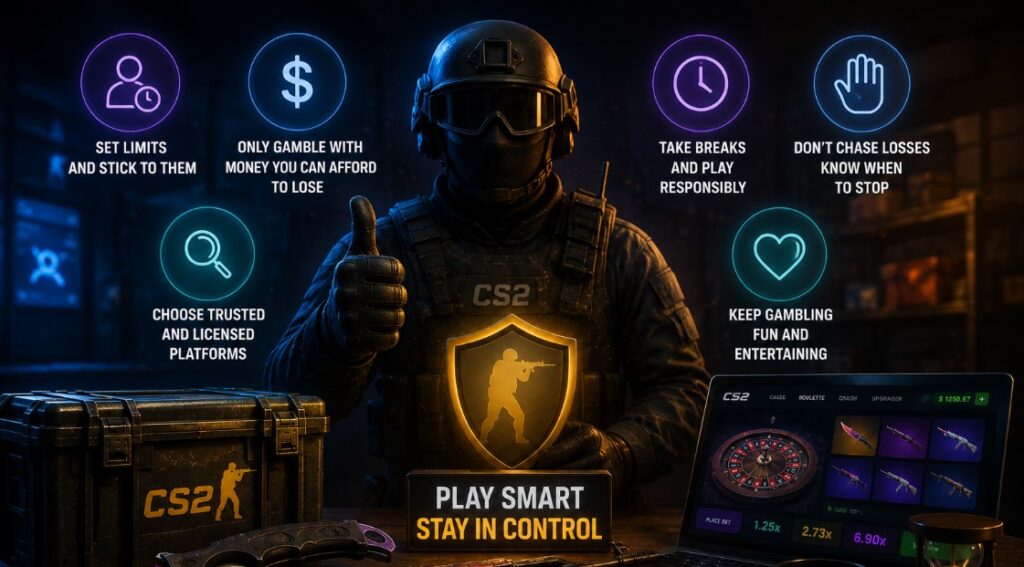
Avoid gambling when emotional, tired, angry, or under pressure. These situations can lead to rushed decisions and higher-risk behavior. Take breaks and avoid long sessions, especially in fast games where wagers can happen quickly.
Always understand the rules before placing a wager. Read bonus terms, check withdrawal conditions, and make sure you know how deposits and payouts work. If a platform offers limits, cooling-off tools, or self-exclusion features, use them when needed.
Do not treat cs2 gambling as income. Do not gamble if you are underage, if gambling is not legal in your region, or if you feel unable to control your activity. Gambling should remain optional entertainment, not a financial necessity or a habit that causes harm.
CS2 gambling refers to gambling activities connected to Counter-Strike 2. It can include skins, roulette-style games, crash games, case openings, live gambling, and match gambling. Depending on the service, users may wager with real money, crypto, platform balance, or CS2 skins.
CS2 skin gambling involves using CS2 skins as value, balance, or potential rewards. Users may deposit skins, convert them into site balance, wager that balance, and potentially withdraw skins or other rewards depending on the platform rules.
CS2 roulette gambling is mainly chance-based. Users may choose different wager types, but the final result is typically determined by a random system. Roulette-style games should not be treated as skill-based or predictable.
CS2 crash gambling usually uses a rising multiplier. Users place a wager and try to cash out before the multiplier crashes. If they cash out in time, they receive a payout based on the multiplier. If the crash happens first, the wager is lost.
CS2 case gambling involves opening virtual cases for a chance to receive skins or other rewards. The outcome depends on item probabilities, and the reward may be worth less than the cost of opening the case.
CS2 match gambling involves wagering on professional Counter-Strike 2 matches or tournaments. Markets may include match winner, map winner, total rounds, handicaps, or tournament results. It still carries risk even for users who understand CS2 esports.
Free cs2 gambling may refer to demo play, free cases, promo balance, no-deposit bonuses, giveaways, or faucet-style rewards. These offers often include restrictions such as wagering requirements, withdrawal limits, expiry dates, or verification rules.
Yes. CS2 skins can have real market value, so losing skins in gambling can be similar to losing money. Users should treat deposited skins as valuable items and only risk what they can afford to lose.
The legality of gambling cs2 activities depends on the user’s country or region. Rules may vary based on age, gambling laws, licensing, payment methods, and whether skins are treated as items of value. Users should check local laws and platform terms before participating.