
CS2 coinflip sites are platforms or game sections where users can take part in coinflip-style gambling, often with CS2 skins, site balance, crypto, or real money depending on the platform.
| Wager type | How it is used | Main thing to check |
| CS2 skins | Users deposit skins and use their estimated value to create or join a coinflip pot. | Check how the platform values skins, whether prices are updated, and what withdrawal options are available. |
| Site balance | Users add funds to an internal account balance and place coinflip wagers from that balance. | Check deposit rules, balance conversion terms, fees, and withdrawal limits. |
| Crypto | Users fund their account with supported cryptocurrencies and use that balance in coinflip games. | Check supported coins, network fees, confirmation times, and withdrawal requirements. |
| Real money | Some platforms may allow fiat deposits through cards, e-wallets, or other payment methods. | Check payment availability, verification rules, processing times, and local legal restrictions. |
Many users search for the best CS2 coinflip sites before depositing items or funds, but the main thing to understand first is how the format works, what risks are involved, and how to evaluate fairness, fees, security, and withdrawals before joining any game.
Quick checklist before using CS2 coinflip sites:
CS2 coinflip sites are gambling platforms where users wager on a two-sided outcome, similar to a coin toss. The result is usually binary: one side wins, the other side loses. Some platforms use simple heads-or-tails themes, while others use red and blue sides, CT and T-side visuals, or other CS2-inspired designs.
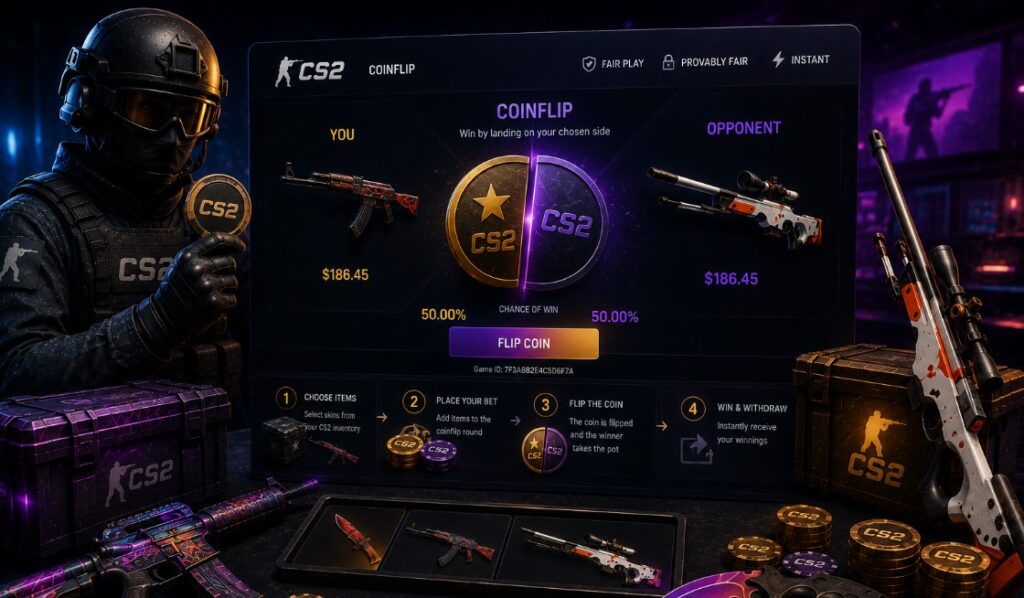
The core idea is simple. You choose or join one side of a game, place a wager, and wait for the result. If the result lands on your side, you win the pot. If it lands on the other side, you lose your wager.
| Step | What happens | What user should check |
| Choose or join a game | The user either creates a new coinflip round or joins an existing one. | Check whether you are playing against another user or against the platform. |
| Select a side | The game assigns or allows the user to choose one of two possible outcomes. | Check how sides are displayed and whether side selection affects anything beyond the visual theme. |
| Place a wager | The user adds CS2 skins, site balance, crypto, or real money to the pot. | Check the wager value, minimum amount, accepted payment type, and whether fees apply. |
| Pot is formed | The total pot is created from all participating wagers. | Check how the platform calculates pot value, especially if skins are involved. |
| Result is generated | A random or provably fair system determines the winning side. | Check whether the result can be verified through fairness tools or round history. |
| Winner receives the pot | The winner gets the combined pot after any platform fee or commission. | Check the fee amount, withdrawal rules, and whether winnings are paid as skins or balance. |
| Loser loses the wager | The losing participant does not get their original wager back. | Make sure the wager fits your budget and avoid chasing losses after the round. |
Different cs2 coinflip sites may handle wagers in different ways. Some allow users to place CS2 skins into the pot. Others use an internal site balance funded by skins, crypto, fiat payments, or other deposit options. In some cases, users play against another player. In others, the platform itself may act as the opposing side.
Coinflip rounds are usually fast, easy to understand, and high-risk. Because the outcome is based on chance, a user can lose skins or funds quickly, especially when placing repeated wagers.
CS2 coinflip gambling usually follows a simple flow:
For example, one player may add CS2 skins worth $20 to a coinflip game. Another player joins with skins or balance of similar value. If the result lands on the first player’s side, that player receives the combined pot, minus any site fee. If the result lands on the other side, the first player loses the original $20 value they entered.
This example is only informational. It does not mean that coinflip gambling is predictable, profitable, or safe. The game is built around a random outcome, and the platform fee can reduce the long-term value of repeated play.
CS2 skins are often used in coinflip gambling because they have visible market value and can be deposited, traded, or converted into site balance on some platforms. A user may deposit skins from their inventory, use those skins directly in a pot, or receive a balance based on the estimated value of the items.
Skin-based coinflip games usually depend on accurate item pricing. If two users are expected to place wagers of similar value, the platform must calculate skin prices fairly. This can be complicated because skin values may change based on market demand, rarity, float value, pattern, stickers, and availability.
| Valuation factor | Why it matters |
| Market demand | Popular skins may rise or fall in value depending on player interest, trends, and trading activity. |
| Rarity | Rare skins usually have higher value, especially when supply is limited. |
| Float value | The skin’s wear level can affect its price, even within the same exterior category. |
| Pattern | Some skins have special patterns that may be worth more than standard versions. |
| Stickers | Rare or valuable stickers can increase a skin’s total market value. |
| Exterior condition | Factory New, Minimal Wear, Field-Tested, Well-Worn, and Battle-Scarred versions can have very different prices. |
| Platform pricing method | A site may value skins differently from public marketplaces, which can affect pot fairness. |
| Inventory availability | Even if a skin has a listed value, the platform may not always have similar items available for withdrawal. |
A typical skin coinflip process may include:
There is also a difference between real skin-to-skin coinflips and balance-based coinflips. In a skin-to-skin format, users may place actual items into a pot. In a balance-based format, skins may first be converted into site credit, and the coinflip uses that internal balance instead of the original items.
Users should also consider trade holds, withdrawal delays, and inventory availability. Even if a user wins a pot, they may not always be able to withdraw the exact same skins immediately. Market price changes, platform restrictions, or limited inventory can affect the final withdrawal experience.
CS2 skins can have real-world value and should be treated like money. Losing a skin in a coinflip game can be financially similar to losing cash.
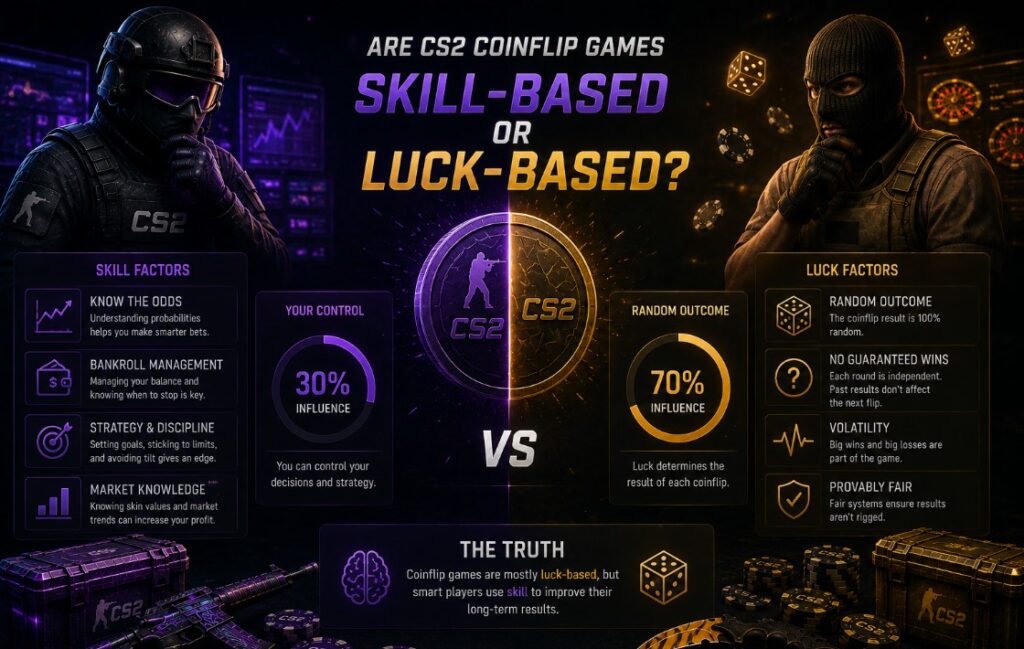
CS2 coinflip gambling is almost entirely luck-based. Once you join a game, you usually cannot influence the outcome. The result is determined by the platform’s random system, provably fair mechanism, or internal round logic.
Previous results do not predict future outcomes. A player winning several rounds in a row does not mean they are more likely to win the next one. A player losing several rounds in a row is also not “due” for a win. This is a common gambling misconception.
Patterns, streaks, and recent history may look meaningful, but they do not create a reliable prediction system. Coinflip games are designed around binary chance, not player skill. Strategy mainly applies to budgeting, choosing whether to play, setting limits, and avoiding emotional decisions.
Any claim about a guaranteed coinflip system should be treated as suspicious. No betting pattern can remove randomness or guarantee consistent profit.
The best CS2 coinflip sites are not defined by flashy visuals or large pots alone. Better platforms are usually easier to evaluate because they provide clear rules, transparent fees, fair result systems, secure account tools, and reliable withdrawal information.

| Evaluation factor | What to look for | Why it matters |
| Transparent game rules | Clear explanation of how games are created, joined, assigned, and resolved. | Users should understand what happens before they place a wager. |
| Pot rules | Information about how wagers are matched, how the pot is calculated, and when winnings are paid. | Unclear pot rules can cause confusion about real wager value and possible returns. |
| Platform fee | Visible commission percentage or fee explanation before the game starts. | Fees reduce the final pot and affect the long-term value of repeated play. |
| Fairness verification | Provably fair tools, public round data, seeds, hashes, or result verification options. | Users need a way to check that results were generated fairly. |
| Skin valuation | Transparent pricing method for skins, including condition, rarity, float, stickers, and market changes. | Incorrect or unclear pricing can make coinflip pots unfair. |
| Deposits and withdrawals | Clear limits, fees, processing times, trade holds, minimum amounts, and available inventory. | Reliable withdrawals are essential when skins or funds have real value. |
| Account security | Secure login, two-factor authentication, anti-phishing guidance, and clear account policies. | Weak security can put balances, skins, and Steam accounts at risk. |
| Responsible gambling tools | Deposit limits, loss limits, session reminders, cool-off periods, or self-exclusion. | These tools help users manage risk and avoid harmful gambling behavior. |
| Legal availability | Clear regional restrictions, age requirements, and access rules. | A platform may not be legally available in every country or region. |
A coinflip platform should explain how games are created, how users join, how sides are assigned, and how the winner is selected. Users should also be able to see whether they are playing against another user or against the platform.
Clear rules reduce confusion. Before joining a coinflip game, you should understand what happens to your wager, what fee applies, how the pot is calculated, and when winnings become available.
Some CS2 coinflip sites may use provably fair systems or public round data. A provably fair system usually allows users to check whether the result was generated in a verifiable way instead of being changed after the wager was placed.
Not every user needs to understand the technical details deeply, but the platform should explain fairness in simple terms. A transparent system should make it possible to verify round results, seeds, hashes, or other fairness data where available.
Skin valuation is important because CS2 items can vary widely in price. Two skins with the same weapon name may have different values because of condition, rarity, float, stickers, or pattern.
A better platform should show how it prices skins and whether prices update regularly. Users should check item values before depositing and before joining a game. Unclear pricing can lead to unfair pot values or unexpected losses.
Deposits and withdrawals are a major part of skin gambling. A platform may look easy to use, but users still need to check withdrawal rules before depositing anything.
Important details include withdrawal limits, processing times, trade holds, fees, minimum withdrawal amounts, and available inventory. A platform with limited skin stock may not always offer the items a user wants to withdraw.
Security matters because skin gambling accounts may hold valuable items or balances. Users should look for secure login options, two-factor authentication, clear account policies, and protection against phishing attempts.
It is also important to confirm that the website address is correct before logging in or depositing skins. Fake gambling pages and impersonation sites can try to steal Steam login details or inventory items.
Responsible gambling tools can help users control their activity. These may include deposit limits, loss limits, session reminders, cool-off periods, or self-exclusion options.
A platform that provides clear responsible gambling controls is generally more user-focused than one that only encourages repeated play. Users should only gamble with money or skins they can afford to lose.
CS2 coinflip sites can vary, but many include similar features. You may see options to create a game, join an existing game, filter by wager size, view public pots, check game history, and review previous results.
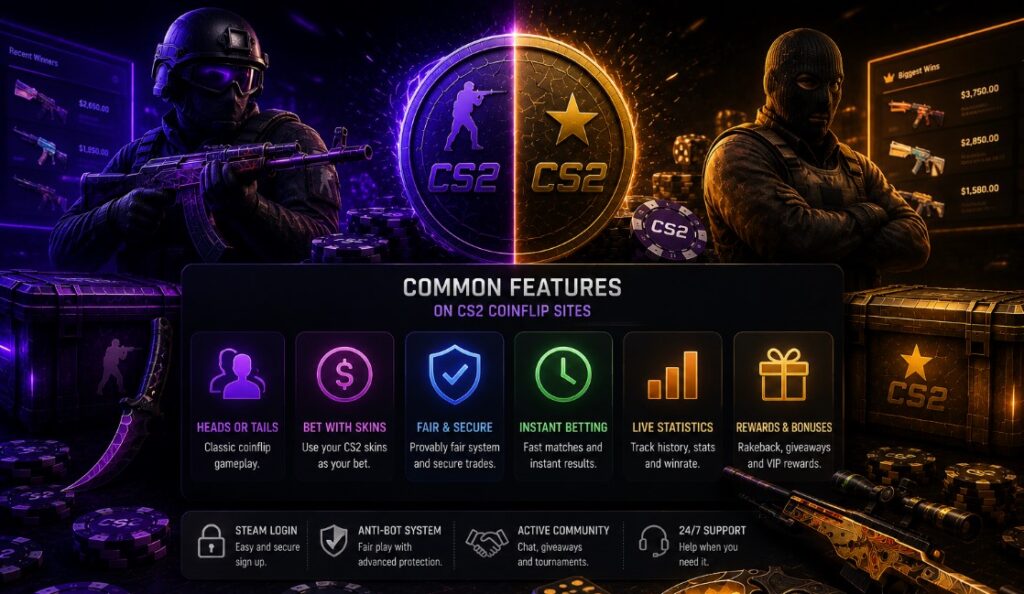
Some platforms also include skin value matching, provably fair verification, chat rooms, leaderboards, crypto or fiat balance support, and mobile access. Skin deposit and withdrawal tools are common on platforms that support CS2 items directly.
These features do not automatically make a platform safe or fair. They should be checked carefully before depositing. A clean interface is useful, but clear terms, fair pricing, transparent fees, and reliable withdrawals matter more.
Many coinflip platforms take a fee from the winning pot or apply commission to each game. This fee may be a fixed percentage, and it can affect the real value of the wager.
| Fee type | When it applies | How it affects the pot |
| Winning pot fee | The platform takes a percentage from the total pot after the winner is selected. | The winner receives less than the full combined pot. |
| Game commission | A fee is applied to each coinflip round, sometimes before or during pot calculation. | The total return is reduced even when the user wins. |
| Skin valuation spread | The platform values deposited skins slightly differently from public market prices. | The displayed pot value may not fully match real market value. |
| Withdrawal fee | A fee is charged when the user withdraws skins, crypto, or balance. | The final amount received may be lower than the visible winnings. |
| Network fee | Crypto transactions may require blockchain network fees. | The user may lose part of the balance during deposits or withdrawals. |
| Minimum fee | A fixed minimum charge applies even to small wagers or withdrawals. | Smaller pots can be affected more heavily by fees. |
| Hidden or unclear fee | The platform does not clearly show the fee before the game starts. | Users may misunderstand the real value of the pot and possible winnings. |
For example, a coinflip may look like a 50/50 game because there are two possible outcomes. However, if the platform takes a commission from the pot, the long-term expected value is not the same as a true even coin toss. The fee means users may receive less than the full combined pot when they win.
This is one reason repeated coinflip gambling can become costly. Even when outcomes are fair and random, the platform fee can reduce long-term returns. Before joining any game, users should check how the fee is calculated, when it is applied, and whether it changes based on wager size or game type.
Some platforms may offer bonuses, free balance, cashback, rakeback, deposit promotions, or other rewards. These offers can look attractive, but the terms matter more than the headline.
Before using any bonus, check the conditions carefully. Important points include wagering requirements, eligible games, expiry dates, minimum deposits, withdrawal limits, and whether coinflip games count toward bonus progress.
Some promotions may exclude skin-based games or limit how much can be withdrawn from bonus winnings. Others may apply bonus abuse rules that restrict repeated claims, multiple accounts, or certain betting patterns.
Users should never deposit only because of a bonus. A promotion does not remove the risk of losing skins or money.
CS2 coinflip gambling carries several risks. The most obvious risk is losing skins or money quickly. Because rounds are fast and simple, users may place multiple wagers in a short period without noticing how much value has been lost.
Another risk is misunderstanding the odds. A coinflip may seem simple, but platform fees, pot rules, and skin valuation can affect the real value of each round. A game with a two-sided outcome is not automatically profitable or evenly priced.
Common risks include:
Users should only gamble with money or skins they can afford to lose. Coinflip gambling should never be treated as a way to earn income, recover losses, or build inventory value.
Legal availability also varies by country or region. Users should check local rules before using any gambling platform. This is not legal advice, and platform access does not always mean the activity is permitted where a user lives.
Safer gambling starts before the first deposit. Set a strict budget and decide in advance how much value you are prepared to risk. Treat CS2 skins as real-value items, not just cosmetic inventory.
Check fees before joining a game. Read withdrawal rules before depositing. Make sure you understand whether the platform uses real skins, site balance, crypto, fiat money, or a mix of different systems.
Avoid chasing losses. Increasing wager size after losing can make losses worse. Do not keep playing because you feel close to a win, and do not assume that a losing streak must end soon.
Use responsible gambling tools where available. Deposit limits, cool-off periods, and self-exclusion can help reduce impulsive play. Stop if coinflip gambling stops feeling recreational or begins to cause stress, financial pressure, or emotional decisions.
CS2 coinflip sites are gambling platforms or game sections where users wager on a two-sided random outcome. Depending on the platform, wagers may involve CS2 skins, site balance, crypto, or real money.
A user creates or joins a coinflip game, adds a wager, and chooses or receives a side. A random or provably fair result is then generated. The winner receives the pot after any platform fee, while the loser loses their wager.
The best CS2 coinflip sites are usually those with transparent rules, clear fees, fair result verification, accurate skin valuation, secure account tools, and reliable withdrawals. This does not require naming specific platforms. Users should evaluate each site carefully before depositing.
Some platforms support CS2 skin deposits and withdrawals, while others use internal balance, crypto, or fiat payment methods. Rules vary by platform, so users should check deposit, valuation, and withdrawal terms before using skins.
Fairness depends on the platform. Some sites may provide provably fair systems or public round data that allows users to verify results. Users should avoid platforms that do not clearly explain how outcomes are generated.
CS2 coinflip gambling is mostly luck-based. Players usually cannot influence the outcome after joining a game. Budgeting and risk management matter, but they do not predict or control the result.
No strategy can guarantee consistent profit on CS2 coinflip sites. Outcomes are random, and platform fees can reduce long-term returns. Claims about guaranteed systems or reliable coinflip prediction methods should be treated with caution.
Legality depends on the user’s country or region. Some areas restrict online gambling, skin gambling, crypto gambling, or access to gambling platforms. Users should check local rules before using any coinflip site.