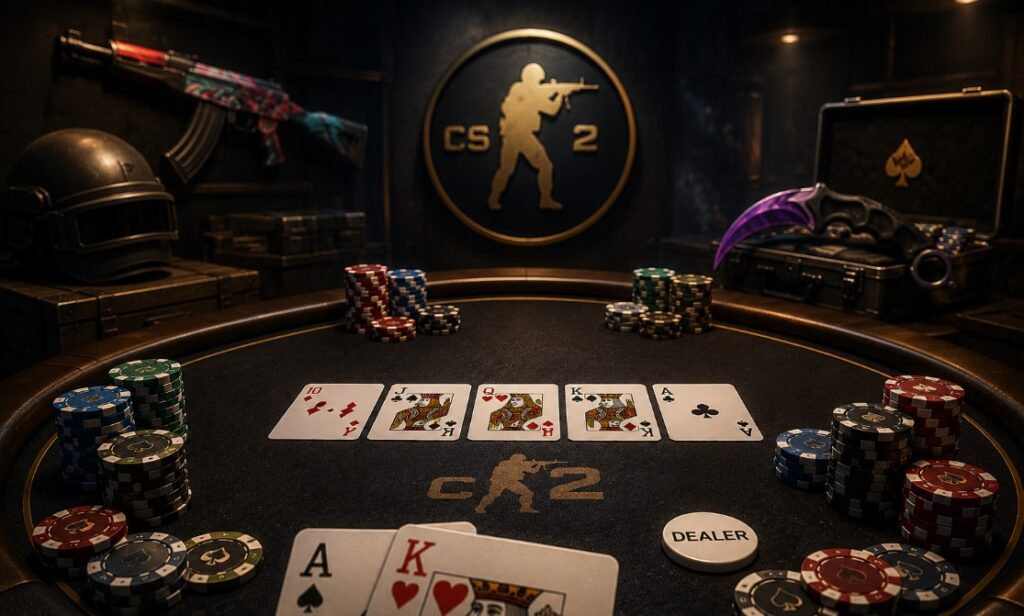
CS2 poker sites may offer poker-style gambling games connected to CS2 skins, internal site balance, crypto, or real-money payment options, depending on the platform.
| Payment or balance type | How it may be used | Main thing to check |
| CS2 skins | Skins may be deposited and converted into site balance, poker chips, or internal credits for table buy-ins. | Check skin valuation, deposit fees, trade restrictions, and whether the same value can be withdrawn later. |
| Internal site balance | Balance may be used to join poker tables, pay tournament buy-ins, or place bets in simplified poker-style games. | Check whether the balance is withdrawable, bonus-linked, or subject to wagering requirements. |
| Crypto | Crypto may be used for deposits, withdrawals, or balance conversion where supported by the platform. | Check supported coins, network fees, confirmation times, withdrawal limits, and verification rules. |
| Real money or fiat | Fiat payment methods may be used to fund an account or withdraw winnings where available. | Check accepted currencies, processing times, payment fees, minimum amounts, and regional availability. |
Many users search for the best CS2 poker sites before depositing skins or funds, but safe evaluation requires more than looking at bonuses or flashy game lobbies. You should understand the poker format, skin valuation, rake, fees, withdrawal rules, platform security, and responsible gambling tools before choosing where to play.

CS2 poker sites are gambling platforms, or specific game sections within CS2 gambling platforms, where users can play poker-style games in the Counter-Strike 2 skins ecosystem. Instead of only using traditional casino chips, some platforms may connect poker gameplay with CS2 skins, site credits, crypto balances, or fiat money.
The exact setup depends on the platform. Some CS2 poker sites may allow skin deposits through Steam trade systems, then convert those skins into an internal balance. Others may use crypto or standard payment methods and keep skins only for withdrawals or marketplace-style transactions. Poker may appear as a traditional table game, a tournament format, a casino poker variant, or a simplified poker-inspired game designed for faster sessions.
Because rules and payout structures can vary, users should not assume that every platform works the same way. Before joining any table, it is important to check the game rules, minimum and maximum stakes, rake, withdrawal options, and account requirements.
The basic process is usually simple, but each step can involve important conditions:
A user creates an account where the service is legally available, then deposits skins, money, crypto, or site balance. If skins are accepted, the platform may assign a value to each item and convert that value into credits, chips, or another internal balance.
After funding the account, the user selects a poker table, format, or tournament. Cards are dealt according to the rules of that specific poker game. During the hand, players may make decisions such as bet, call, raise, fold, or check. The hand is then resolved based on poker hand rankings, betting actions, and the rules of the table.
For example, a player might join a low-stakes table using site balance converted from CS2 skins. They receive cards, decide whether to stay in the hand, and make betting decisions as more cards are revealed. They may win the pot if their final hand is stronger, or lose their stake if they fold or are beaten at showdown.
Any winnings are usually added to the account balance. Withdrawals may be available as skins, crypto, fiat, or another supported method, but limits, fees, KYC checks, and item availability can affect the process.

Available poker formats vary from one platform to another.
| Poker format | How it works | What users should check |
| Texas Hold’em | Players receive private cards and use shared community cards to make the best five-card hand. | Check blind levels, betting limits, rake, table rules, and whether the game is player-vs-player. |
| Casino poker or dealer poker | The player competes against the dealer instead of other users, often with fixed rules and payout conditions. | Check the payout table, house edge, side bets, minimum stake, and how results are generated. |
| Poker tournaments | Users pay a fixed buy-in and compete for a prize pool until players are eliminated or paid positions are reached. | Check buy-in cost, tournament fee, prize distribution, blind structure, late registration, and withdrawal rules. |
| Simplified poker-style games | The game uses poker hands or card combinations but may remove deeper betting rounds for faster gameplay. | Check whether it follows real poker rules, what decisions the user controls, payout odds, speed, and platform fees. |
Some services may offer traditional poker tables, while others may use simplified versions that only borrow certain poker mechanics.
Poker includes both skill and chance. This is one reason it feels different from many CS2 gambling formats, but it does not make the game risk-free.

Luck affects every poker session because card distribution is random. A strong starting hand can still lose, and a weak hand can sometimes improve. Short-term variance can be especially noticeable in fast sessions, small sample sizes, or tournaments where one lost hand can eliminate a player.
Unexpected hands, unlucky rivers, aggressive opponents, and tournament swings can all affect results. Even experienced players cannot control which cards are dealt.
Skill affects how a player responds to the cards they receive. Important poker skills include understanding hand rankings, reading betting patterns, managing position, knowing when to fold, and avoiding emotional decisions. Bankroll management is also important because poor stake selection can lead to quick losses even when a player understands the rules.
Skill can improve decision-making over time, but it cannot remove risk or guarantee profit. Poker remains gambling, especially when real-value skins, money, or crypto are involved.
CS2 skins can be connected to poker gambling in several ways. A platform may allow users to deposit skins, convert them into site balance, and use that balance for poker buy-ins or table stakes. Some platforms may represent this balance as poker chips, internal credits, or another account currency.
Withdrawals may also involve skins, but users should check the details carefully. Skin availability can change, market prices may move, and some items may not be withdrawable at the same value shown during deposit. Trade restrictions, Steam limitations, platform fees, and marketplace spreads can all affect the final value a user receives.
CS2 skins can have real-world value and should be treated like money. Depositing a skin into a gambling platform means accepting the risk of losing that value during play.
The best CS2 poker sites are not defined by one bonus, one lobby design, or one promotional claim. A safer and more useful way to evaluate a platform is to look at transparency, fair gameplay, payment reliability, security, and user protection.
| Evaluation factor | What to look for | Why it matters |
| Transparency | Clear poker rules, hand rankings, table limits, rake, fees, and withdrawal conditions. | Users should understand how the game works and what costs apply before depositing skins or funds. |
| Fair gameplay | Information about card dealing, RNG systems, provably fair tools where applicable, and visible game history. | Fairness systems help users see whether outcomes are generated in a reliable and verifiable way. |
| Payment reliability | Supported deposit and withdrawal methods, processing times, limits, KYC rules, and skin withdrawal availability. | Reliable payments reduce the risk of delayed withdrawals, unexpected fees, or locked balances. |
| Security | Secure login, two-factor authentication, account verification, and phishing protection. | Strong account protection helps keep skins, funds, and personal data safer. |
| User protection | Deposit limits, loss limits, cool-off periods, session reminders, and self-exclusion tools. | Responsible gambling features help users manage risk and stop when play is no longer recreational. |
A poker platform should explain its rules before users play. This includes hand rankings, table limits, blind structure, betting rules, rake, tournament fees, payout conditions, and withdrawal requirements. If important rules are hidden or difficult to understand, users should be cautious.
Fair dealing is essential. Users should look for information about random card distribution, audited RNG systems, provably fair mechanics where applicable, and transparent game history. A platform should make it possible to understand how outcomes are generated and how disputes are handled.
Before depositing skins or money, users should check deposit processing times, withdrawal limits, fees, KYC requirements, and supported payout methods. For skin withdrawals, it is also important to check whether the platform has enough item liquidity and whether users can withdraw comparable value.
Rake is the fee taken by the platform from pots or tournaments. Even small rake percentages can affect long-term results, especially for frequent players. Clear rake information helps users understand the real cost of playing.
Responsible gambling tools are important on any gambling platform. Useful features may include deposit limits, loss limits, cool-off periods, session reminders, self-exclusion, and account reality checks. These tools help users control spending and stop when gambling stops feeling recreational.
A reliable platform should support secure login, two-factor authentication, account verification, and protection against phishing. Users should also check whether the platform has clear account recovery procedures and warnings about fake links or impersonation scams.

Poker usually involves more decision-making than many fast CS2 gambling formats. However, more decisions do not remove financial risk.
| Feature | Poker | Blackjack | Coinflip | Crash | Roulette |
| Player decisions | High | Moderate | Very low | Low | Very low |
| Skill influence | Higher | Moderate | Minimal | Minimal | Minimal |
| Speed | Moderate | Moderate | Fast | Fast | Fast |
| Main risk | Poor decisions, variance, rake | House edge | Random outcome | Sudden crash | Random outcome |
| Best for | Users who understand poker rules | Table game players | Simple chance games | Fast multiplier games | Chance-based betting |
Poker may appeal to users who want more strategy and decision-making, while games like coinflip, crash, and roulette are usually faster and more chance-based. Still, poker can be risky because bad decisions, variance, rake, and emotional play can all lead to losses.

Rake is one of the most important poker-specific costs. It is usually taken from pots in cash games or added as a fee on tournament buy-ins. For example, a tournament may have a buy-in plus a separate fee, while a cash table may take a small percentage from eligible pots.
Buy-ins define how much value a player needs to enter a table or tournament. Table limits control the minimum and maximum stakes. These limits matter because playing too high can quickly damage a user’s balance.
Bankroll management means setting aside a fixed amount for poker and choosing stakes that fit that limit. It helps reduce the chance of losing everything in a short session. Variance can still cause losses, even when decisions are reasonable, so users should never play with skins or money they cannot afford to lose.
Fees affect long-term results because they reduce the amount returned to players over time. A platform with unclear rake, hidden withdrawal fees, or poor skin valuation can make poker more expensive than it first appears.
Some CS2 poker sites may offer bonuses, rakeback, cashback, deposit rewards, tournament tickets, or free balance. These offers should be reviewed carefully because bonus terms can significantly affect usability.
Users should check wagering requirements, eligible games, expiry dates, minimum deposits, withdrawal limits, and whether poker contributes to bonus progress. Some bonuses may exclude poker or count poker at a reduced rate. Rakeback can also have limits, tiers, or activity requirements.
It is also important to read bonus abuse rules. Multiple accounts, restricted regions, irregular betting patterns, or failure to complete verification may cause a bonus or withdrawal to be rejected. A bonus should never be the only reason to use a platform.
CS2 poker gambling carries financial and personal risks. Users can lose money, skins, crypto, or site balance. Because poker includes skill, some players may overestimate their advantage and move to higher stakes too quickly. Short-term variance can also create the false impression that a player is either better or worse than they actually are.
| Risk | What it means | What users should check or limit |
| Losing money or skins | Poker can result in the loss of deposited funds, CS2 skins, crypto, or site balance. | Set a fixed budget and only use money or skins you can afford to lose. |
| Overestimating skill | Because poker involves decisions, some users may believe they have more control than they actually do. | Avoid moving to higher stakes too quickly and do not assume skill removes risk. |
| Short-term variance | A player can win or lose several hands in a row because card outcomes are random. | Do not judge results from a short session and avoid chasing losses after unlucky hands. |
| Playing too high | Large buy-ins or table limits can drain a balance quickly. | Check minimum and maximum stakes before joining a table or tournament. |
| Rake and fees | Platform fees can reduce the value of pots, tournament entries, or withdrawals. | Review rake, tournament fees, deposit fees, withdrawal fees, and skin valuation rules. |
| Withdrawal restrictions | Some platforms may apply limits, delays, KYC checks, or item availability rules. | Read withdrawal terms before depositing and check processing times, limits, and verification steps. |
| Unsafe platforms | Unlicensed or unclear platforms may have weak security, unfair systems, or poor dispute handling. | Check licensing information, account protection tools, fairness details, and support options. |
| Gambling harm | Repeated play can become stressful or harmful, especially when trying to recover losses. | Use limits, take breaks, avoid emotional play, and stop if poker no longer feels recreational. |
Rake reduces returns over time, and withdrawal rules can affect access to funds or skins. Unsafe or unlicensed platforms may present additional risks, including unclear ownership, poor dispute handling, delayed withdrawals, weak security, or unfair game systems.
Bonus terms may limit withdrawals, and legal availability depends on the user’s country or region. Users should not treat general information as legal advice and should check local rules before gambling.
There is also a risk of gambling-related harm. Users should only play with money or skins they can afford to lose. Gambling should remain recreational, not a way to solve financial problems or recover previous losses.
Before playing poker with CS2 skins or money, learn the basic rules and hand rankings. Start with low stakes if you choose to play, and decide on a strict budget before depositing. Do not chase losses, raise stakes out of frustration, or continue playing when tired, angry, or emotional.
Check rake, tournament fees, and withdrawal rules before sending skins or funds to a platform. Treat CS2 skins as real-value items, even if they are shown as credits or chips inside the site. Use available responsible gambling tools such as limits, cool-offs, and self-exclusion.
If poker stops feeling recreational, take a break. If gambling begins to affect finances, relationships, work, or mental health, stop playing and consider seeking support from a professional or a local gambling help service.
CS2 poker sites are gambling platforms or game sections that offer poker-style games connected to CS2 skins, site balance, money, or crypto. The exact deposit, gameplay, and withdrawal systems depend on the platform.
A user usually creates an account, deposits skins or funds, chooses a poker table or tournament, makes betting decisions during the hand, and wins or loses based on poker rules. Withdrawals may be available through skins, crypto, fiat, or other supported methods.
The best CS2 poker sites are usually transparent about rules, rake, deposits, withdrawals, security, and responsible gambling tools. Instead of relying on rankings, users should evaluate how clearly a platform explains gameplay, fees, fairness, and account protection.
Some platforms may support CS2 skin deposits or withdrawals, but rules vary. Users should check how skins are valued, whether fees apply, which items are available, and whether withdrawals are subject to limits or verification.
CS2 poker can involve skill because players make decisions about betting, folding, position, and bankroll management. However, poker also includes luck because cards are dealt randomly. Skill can improve decisions but cannot guarantee profit.
Rake is a fee taken by the platform from poker pots or tournaments. It is one of the main costs of playing poker and can affect long-term results.
No result is guaranteed. Poker includes variance, fees, and risk. Even skilled players can lose, especially over short periods or when playing at unsuitable stakes.
Legality depends on the user’s country, region, age, and the platform’s licensing rules. Users should check local laws and platform terms before gambling. This information is educational and should not be treated as legal advice.